Overview
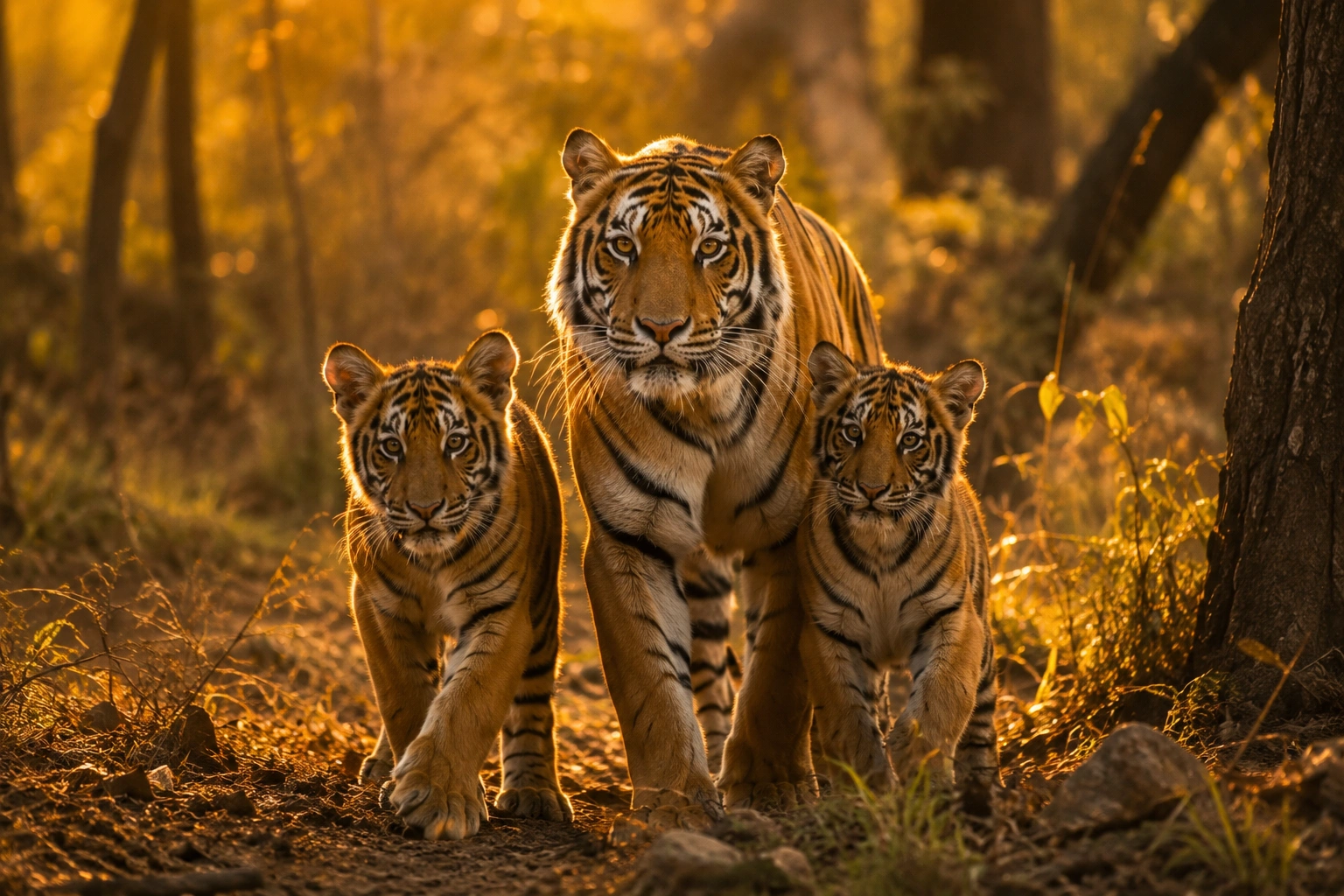
Jim Corbett National Park, spread across the Nainital and Pauri Garhwal districts of Uttarakhand in the foothills of the Himalayas, is India's oldest national park and the birthplace of Project Tiger, the country's flagship tiger conservation programme. It's home to one of the highest densities of wild Bengal tigers anywhere in the world, alongside wild Asian elephants, leopards, over 600 recorded bird species, and a landscape that shifts from dense sal forest to open grassland to riverbank within a single day's safari.
The park takes its name from Edward James "Jim" Corbett — a hunter-turned-conservationist whose own transformation, from tracking man-eating tigers to campaigning for their protection, mirrors the story of the park itself. What was carved out in 1936 to protect a vanishing forest is now, nine decades later, one of the clearest conservation success stories in Asia.
This guide covers the park from every angle: its history and the man behind its name, its geography and rivers, its complete list of flora and fauna, a full breakdown of all ten safari zones, and the practical detail — climate, how to reach it, and what's nearby — that a first-time visitor actually needs. If you're ready to book, our safari booking page and luxury safari package pick up from here.
History of Jim Corbett National Park
Before it was a national park, this stretch of forest in the Kumaon foothills belonged to the princely state of Tehri Garhwal, later ceded in part to the East India Company. Local Boksa communities farmed parts of the Terai here until they were displaced in the 1860s, and it was British officer Major Ramsay who first put a conservation plan in place for the area in 1858, ending decades of unchecked exploitation.
The idea of formally protecting this forest took shape slowly. British foresters E.R. Stevans and E.A. Smythies pushed for a wildlife reserve in the early 1900s, and a game reserve was first proposed in 1907. It took until 1930 for the actual demarcation to begin — carried out in consultation with Jim Corbett himself, who by then was already well known in the region as a tracker and hunter. In 1936, the United Provinces National Park Act was passed, and the reserve — an initial 323.75 sq km — opened as Hailey National Park, named for Sir Malcolm Hailey, then Governor of the United Provinces. It was mainland Asia's first national park.
From the outset, hunting was banned inside the park and timber cutting was restricted to domestic use. That progress nearly unravelled during the Second World War, when wartime demand drove a period of heavy poaching and illegal logging. The park recovered in the decades after independence: it was renamed Ramganga National Park in 1954-55, and then, in recognition of Jim Corbett's role in its founding and his tireless advocacy for wildlife, renamed a final time in the mid-to-late 1950s to the name it carries today.
The most significant chapter came in 1973, when Corbett was chosen as the launch site for Project Tiger — India's national programme to save the Bengal tiger from extinction. In 1991, the reserve's protected area grew substantially with the addition of roughly 798 sq km of buffer zone, including the Kalagarh division of the neighbouring Sonanadi Wildlife Sanctuary, bringing the full Corbett Tiger Reserve to its present size.
It's worth pausing on how close the park came to being lost entirely during the war years. With British administrative attention pulled toward the war effort and enforcement staff stretched thin, timber contractors and poachers moved into areas that had been off-limits for decades. Tiger and elephant numbers, which had been slowly recovering under Major Ramsay's and later administrators' protections, dropped sharply. The park's post-independence renaming — first to Ramganga, then to Corbett — coincided with a broader rebuilding period, as the newly independent Indian state began investing seriously in forest administration and wildlife law for the first time.
Corbett National Park vs. Corbett Tiger Reserve — What's the Difference?
These two names are often used interchangeably, but they mean slightly different things, and understanding the distinction helps explain the zone system covered later in this guide. Corbett National Park refers specifically to the original ~521 sq km core area — the strictly protected inner zone where hunting, grazing, and human settlement have been prohibited since 1936. Corbett Tiger Reserve is the larger administrative unit, roughly 1,288 sq km, that wraps the national park in buffer forest divisions — including the Kalagarh and Ramnagar forest divisions and the adjoining Sonanadi Wildlife Sanctuary — where some regulated human activity, forestry, and tourism infrastructure is permitted. When people say "Corbett," they're almost always referring to the Tiger Reserve as a whole, since that's the area most of the safari zones actually sit within.
Who Was Jim Corbett?
Edward James Corbett was born on 25 July 1875 in Nainital, in the Kumaon foothills of the Himalayas, and grew up immersed in the forests that would later carry his name. He reportedly shot his first leopard before the age of nine, and by his twenties had built a reputation across the Kumaon-Garhwal region as an exceptional tracker and marksman — skills that led the Government of the United Provinces to repeatedly call on him to hunt down man-eating tigers and leopards terrorising villages.
Between roughly 1907 and 1938, Corbett hunted down more than a dozen confirmed man-eaters, together responsible for over 1,500 human deaths. His first major case, the Champawat Tiger, had already killed an estimated 436 people by the time he tracked it down in 1907 — still one of the highest death tolls attributed to a single animal in recorded history. He held the rank of Colonel in the British Indian Army and worked, often alone and at real personal risk, entirely on request from local administrations rather than for sport.
What sets Corbett apart from his hunting contemporaries is what came after. As he grew older, he increasingly traded his rifle for a camera, and became one of the earliest and most persistent voices arguing that India's forests and wildlife needed active protection, not just occasional hunting bans. His books — most famously Man-Eaters of Kumaon (1944), along with Jungle Lore and several others — combined firsthand hunting accounts with vivid, affectionate descriptions of the Kumaon wilderness, and did more than almost anything else to bring international attention to the region's wildlife.
Corbett left India for Kenya in 1947, around the time of independence, and spent his final years there, still writing about wildlife until his death on 19 April 1955. Two years later, the park that already owed so much to his early advocacy for its protection was renamed in his honour — a rare case of a place being named not after a ruler or a battle, but after someone who spent his later life arguing that a wild landscape was worth protecting for its own sake. That argument, made in the 1930s and 40s when it was very much a minority view, is essentially the founding logic behind every national park and tiger reserve India has created since.
Geography & Location
Jim Corbett National Park sits in the Nainital and Pauri Garhwal districts of Uttarakhand, in the outer foothills of the Himalayas known as the Shivalik range, at elevations ranging from roughly 1,300 to 4,000 feet (400–1,200 m). The terrain is genuinely varied for a single park — steep forested ridges, wide river valleys, rolling grassland "chaurs," and a large reservoir — which is part of why its wildlife is so diverse.
The core national park covers about 521 sq km (201 sq mi). It sits within the much larger Corbett Tiger Reserve, which totals approximately 1,288 sq km (497 sq mi) once the buffer forest divisions and the adjoining Sonanadi Wildlife Sanctuary are included. The nearest town and the main gateway for visitors is Ramnagar, roughly 260 km from Delhi.
Geologically, the park sits at the meeting point of the Himalayan foothills and the Gangetic plains — the transition zone often called the "Terai-Bhabar" belt. This position is a large part of why the biodiversity here is so layered: species typical of the Himalayan lower slopes overlap with species from the northern plains, within a park small enough to cross in a single day's drive. The Patli Dun valley, where Dhikala sits, is the most striking example of this — a wide, flat valley carved by the Ramganga between two forested ridgelines, functioning almost like a natural amphitheatre for wildlife.
Rivers & Water Bodies
Water is what makes Corbett's wildlife so concentrated and so visible, and the park is unusually well supplied with it for a Himalayan-foothill reserve.
- Ramganga River — the park's lifeline. A rain-fed river originating near Gairsain in the Lesser Himalayas, it flows roughly 40 km through the park before entering the plains near Kalagarh, gathering the Sonanadi, Mandal, and Palain rivers along the way. A dam near Kalagarh forms a large reservoir inside the reserve that draws migratory waterbirds every winter.
- Kosi River — runs along the park's eastern boundary without entering it directly, flowing from Mohan through Dhikuli to Ramnagar. It doesn't feed the core zones but remains critical for wildlife and communities around the park's edge, and most riverside resorts near Ramnagar sit along its banks.
- Sonanadi, Mandal & Palain — the Ramganga's main tributaries inside the reserve, each supporting their own pockets of riverine forest and birdlife, and each lending its name to a corner of the reserve (the Sonanadi Wildlife Sanctuary, for instance).
The Ramganga is home to the endangered gharial and the mugger crocodile, along with otters, turtles, and the mahseer — a powerful freshwater game fish anglers travel specifically to Corbett to pursue. During the dry summer months, as smaller streams and pools disappear, the Ramganga and its main tributaries become the single most reliable place in the park to sit and wait for wildlife to come to you, which is exactly why so many of Corbett's best-known tiger sightings happen streamside between March and June.
Climate Through the Year
Corbett's foothill location gives it a noticeably wider temperature swing than most of India's plains-based tiger reserves.
- Winter (November–February): Cool and dry, with early mornings dropping close to 5°C and daytime highs around 20-25°C. The most comfortable season for safaris, and the busiest — pack real layers for the open jeep at dawn.
- Summer (March–June): Hot and dry, with daytime temperatures regularly crossing 35-40°C by May-June. Uncomfortable for people, but the best window for wildlife sightings, as animals concentrate around the shrinking rivers and waterholes.
- Monsoon (July–October): Heavy rainfall driven by the southwest monsoon. The core zones close entirely during this period, both for visitor safety and because it's the wildlife breeding season.
Within those broad seasons, a few months stand out for specific reasons. December and January are the coldest, foggy in the early mornings but crystal clear by mid-morning — good for photography once the mist lifts. April and May are the hottest and, for many repeat visitors, the single best sighting window of the year, since predictable water sources mean predictable animal movement. Mid-November, right as the core zones reopen after monsoon, is an underrated month: the forest is still green from the rains, temperatures are mild, and visitor numbers haven't yet reached the December-January peak.
Flora — Forest, Grassland & Vegetation
Corbett's plant life is remarkably rich for its size: well over 600 species of trees, shrubs, herbs, bamboo, grasses, climbers, and ferns have been recorded inside the reserve, spread across four broad habitat types.
- Sal forest (~73% of the park) — the dominant vegetation type, a dense, moist deciduous forest built around the sal tree (Shorea robusta), interspersed with khair, sissoo, haldu, rohini, and kanju.
- Chaurs, or grasslands (~10% of the park) — the open, elephant-grass meadows that make Dhikala so distinctive, and where most large grazing animals — and the predators that follow them — are easiest to spot.
- Riverine forest — the belt of vegetation that follows the Ramganga and its tributaries, generally the most biodiverse strip in the park.
- Mixed dry deciduous forest — found on the drier, higher ridges away from the rivers.
Seasonal flowering trees like kachnar, semal (silk cotton), dhak (flame of the forest), and amaltas (Indian laburnum) add bursts of colour through the spring, particularly noticeable on a March-April safari. Bamboo grows thickly along several riverbanks and forms a favoured feeding ground for elephants, while the forest floor beneath the sal canopy stays remarkably open — sal trees suppress most undergrowth around them, which is part of why sal forest offers some of the best sightlines for spotting animals compared to denser jungle types elsewhere in India.
The chaurs deserve special mention: these open, seasonally flooded grasslands — Dhikala's in particular — are what give Corbett its reputation for dramatic, wide-open sightings, in contrast to reserves where every sighting happens through a screen of trees. They're maintained partly by natural flooding from the Ramganga and partly by controlled grazing pressure from the resident elephant and deer populations, which keep them from reverting to forest.
Fauna — The Complete Wildlife Guide
Corbett's biodiversity is genuinely exceptional: around 50 species of mammals, 600+ species of birds (more than the whole of Europe, and roughly a quarter of everything recorded in India), and 25 species of reptiles, alongside a healthy population of fish and amphibians.
Royal Bengal Tiger
The flagship species and one of the highest tiger densities of any reserve in India — most active at dawn and dusk near water.
Asian Elephant
Large wild herds, especially visible in the Dhikala grasslands during the warmer months near the Ramganga.
Leopard
More elusive than the tiger and often more active in the drier, scrubbier zones like Jhirna and Dhela.
Sloth Bear
Present but rarely seen — mostly nocturnal, and easiest to spot near fruiting trees in the pre-monsoon months.
Deer & Antelope
Spotted deer (chital), sambar, hog deer, and barking deer are common across every zone, and are often the first sign of a nearby predator.
Wild Boar & Jackal
Frequently seen along forest tracks and grassland edges, especially in the early morning shift.
Gharial & Mugger Crocodile
Both bask along the Ramganga; the gharial, with its distinctive narrow snout, is a globally endangered species.
600+ Bird Species
Including 49 of India's 69 recorded raptor species — crested serpent eagles, changeable hawk-eagles, and more.
Otters & Yellow-Throated Marten
Less commonly spotted, but present along the riverbanks and denser forest patches respectively.
Mahseer Fish
A prized game fish found in the Ramganga, drawing anglers as well as wildlife watchers to its banks.
Corbett's Tiger Numbers
The Forest Department carries out a formal tiger census every few years as part of the national All India Tiger Estimation exercise, and Corbett has consistently placed among the top two or three reserves in the country by tiger count — its combination of prey density, water availability, and long-standing protection makes it unusually good tiger habitat even by the standards of India's other major reserves. Exact numbers shift with each census cycle, so we'd rather point you to the Forest Department's own published figures than quote a number that's likely to be outdated by the time you read this.
Birdwatching at Corbett
Ornithologists rank Corbett among the finest birding destinations in Asia, and the numbers back it up: over 600 recorded species is roughly a quarter of everything found across the Indian subcontinent, and genuinely more than the total number of bird species recorded across the whole of Europe. The variety comes from the same layered geography that supports the park's mammals — resident forest species, riverine specialists along the Ramganga and Kosi, grassland birds in the chaurs, and a substantial winter migratory population that arrives from Central Asia and Siberia to overwinter on the Kalagarh reservoir.
Serious birders tend to gravitate toward the Durga Devi and Sitabani zones specifically, both known for species like the grey-headed fishing eagle, black-chinned yuhina, crested laughing thrush, and long-tailed broadbill, alongside 49 of India's 69 recorded raptor species — including the crested serpent eagle and changeable hawk-eagle, both commonly seen from a jeep in almost any zone.
All Safari Zones of Jim Corbett — Complete Guide
Corbett is managed as several distinct ecotourism zones rather than one open park, each with its own entry gate, permit, and vehicle cap, designed to spread visitor traffic and reduce pressure on any single stretch of forest. Here's every zone in one place.
| Zone | Known For | Open Season | Best Suited For |
|---|---|---|---|
| Dhikala | The core zone — largest, highest tiger density, huge chaur grasslands, elephant herds | Mid-Nov – Jun | Canter safari, Forest Rest House night stay |
| Bijrani | The classic Corbett safari zone — closest to Ramnagar, open forest and grassland, strong tiger record | Mid-Oct – Jun | Day visitors, first-time safaris |
| Garjiya | Scenic, tranquil landscape close to the Ramnagar/Dhikuli resort belt | Mid-Oct – Jun | Easy access, strong year-round visitor demand |
| Dhela | Community-run eco-tourism zone next to Jhirna, consistently good tiger sightings | Year-round | Monsoon-season travel, reliable tiger sightings |
| Hathi Dagar | Corbett's newest zone (opened March 2024), an elephant corridor with low visitor numbers | Year-round | Curious repeat visitors, quiet safaris |
| Durga Devi | Hilly, northeastern zone at the Ramganga-Mandal confluence — elephants, river views, exceptional birding | Mid-Nov – Jun | Birdwatchers, anglers |
| Jhirna | Open through the monsoon, leopard country, reliable sightings year-round | Year-round | Monsoon-season travel, fixed dates |
| Phato | An emerging zone on the newer side of the circuit, dense tiger territory, noticeably fewer jeeps | Mid-Nov – Jun | A quieter, more exclusive safari |
| Sitabani | Buffer zone outside the core reserve — old temples, mythology, forest walks, relaxed permit rules | Year-round | Birding, casual visits, private vehicles |
| Pakhro | A different gateway entirely — reached via Kotdwar, not Ramnagar, in the Sonanadi Range's sal and bamboo forest | Mid-Oct – Jun | A niche, off-the-radar eco-tourism visit |
A Closer Look at Each Zone
Dhikala is Corbett's crown jewel and its most in-demand zone by far — the wide Patli Dun valley, framed by the Ramganga on one side and forested ridges on the other, offers the park's most dramatic open-grassland scenery and its highest concentration of elephant herds. Day visitors reach it only by Canter; a night at the Forest Rest House here is as close as most people will ever get to sleeping inside genuine tiger habitat.
Bijrani is the classic, most-booked Corbett safari zone for a reason — its Aamdanda gate sits barely a kilometre from Ramnagar, cutting transfer time to almost nothing, and its mix of open forest and grassland delivers some of the park's most consistent tiger sightings, making it the natural first choice for a first-time visitor.
Garjiya trades a little of Bijrani's tiger-sighting reputation for something else entirely: an unusually tranquil, scenic landscape right in the heart of the Ramnagar/Dhikuli resort belt, along the Kosi. Its accessibility is exactly why it sees such strong, steady visitor demand year after year, even among travellers who've already done the more famous zones.
Dhela sits beside Jhirna in the park's south and shares its year-round access — but it's built around a genuine community-tourism model, with a real share of its guide and safari jobs held by residents of the surrounding villages, and it has built a solid reputation for consistent tiger sightings in its own right, not just as a monsoon-season fallback.
Hathi Dagar is the newest name on this list, inaugurated in March 2024 — its name literally means "elephant's path," reflecting its role as a genuine elephant corridor. Reached via the Durga Devi gate, it's still lightly visited relative to the older zones, which is exactly its appeal: low crowd numbers and the particular curiosity that comes with a genuinely new part of the park.
Durga Devi, in the park's hilly northeast where the Ramganga meets the Mandal, is where elephants, river scenery, and birdlife come together most completely — it trades a bit of tiger-sighting consistency for a quieter, more scenic drive and some of the best birding anywhere in the reserve.
Jhirna is one of only two zones that stay open right through the monsoon closure, and its drier, scrubbier terrain makes it consistently good leopard country alongside reliable tiger sightings — a dependable choice whenever your travel dates are fixed regardless of season.
Phato is one of the circuit's newer, still-emerging zones — dense tiger territory with noticeably fewer jeeps on the track than the established zones, which appeals strongly to photographers and repeat visitors who've already covered Dhikala and Bijrani and want something quieter.
Sitabani sits outside the core Tiger Reserve entirely, in the buffer forest, which means simpler permits, private vehicles, and a genuinely different kind of visit — old temples and local mythology woven through the forest walks, alongside some of the park's best casual birding.
Pakhro is the one zone on this list that isn't reached from Ramnagar at all — it sits in the Sonanadi Range, accessed via Kotdwar on the opposite side of the reserve, through dense sal and bamboo forest. That different gateway is exactly why it draws a smaller, more niche eco-tourism crowd rather than the mainstream Ramnagar-side visitor flow.
For a deeper look at how to choose between them — including which zones pair best with which resorts — see our zone-by-zone breakdown on the luxury safari page, or head straight to check availability for your dates.
How Many Vehicles & Guests Are Allowed Per Day?
This is one of the most common questions we get, and the forest department publishes fairly specific numbers. Across the main day-visit zones, roughly 180 jeeps are permitted to enter Corbett per day, split across the morning and afternoon shifts:
| Zone | Approx. Vehicles / Day* | Guests Per Vehicle |
|---|---|---|
| Bijrani | ~60 jeeps | Up to 6 (excl. guide & driver) |
| Jhirna | ~60 jeeps | Up to 6 (excl. guide & driver) |
| Dhela | ~15 jeeps | Up to 6 (excl. guide & driver) |
| Durga Devi | ~15 jeeps | Up to 6 (excl. guide & driver) |
| Garjiya | ~15-20 jeeps | Up to 6 (excl. guide & driver) |
| Hathi Dagar / Phato / Pakhro | Smaller, lower-traffic quotas | Up to 6 (excl. guide & driver) |
| Dhikala (Canter) | A separate, smaller quota of 16-seat Canters | Up to 16 per Canter |
*Vehicle quotas are set and periodically revised by the forest department based on scientifically calculated carrying capacity — always confirm current numbers at the time of booking.
Doing the maths on the day-visit zones alone, that puts the realistic day-visitor ceiling at roughly 1,000-1,100 guests per day across Bijrani, Jhirna, Dhela, and Durga Devi combined — before adding Dhikala's separate night-stay and Canter allocation. Only two safari shifts run per day, morning (roughly 6:00-9:30 AM) and afternoon (roughly 2:00-5:30 PM), and private vehicles are never allowed inside — every visitor travels in an officially registered jeep or Canter with a naturalist guide.
Responsible Tourism at Corbett
Corbett's tiger density is a direct result of decades of protection, and that protection depends on visitors treating the rules as more than bureaucracy. Vehicle caps per zone exist because too many jeeps genuinely does disturb animal behaviour, not just visitor experience. Staying inside your vehicle in the core zones isn't just for your safety — leaving it disturbs the ground-level habitat that ground-nesting birds and smaller mammals depend on. And the ban on drones isn't unique to Corbett; it reflects a nationwide rule across India's tiger reserves, driven by evidence that aerial noise measurably stresses wildlife.
The most meaningful thing a visitor can do is simple: book through a Forest Department-recognised permit channel rather than an informal reseller, follow your guide's instructions without negotiating around them, and treat a quiet, patient safari as the goal rather than a guaranteed photograph. The zones that feel calmest to visit are, not coincidentally, usually the ones with the best long-term sighting records too.
In concrete terms, here's the honest do's-and-don'ts list the Reserve enforces strictly under the Wildlife Protection Act — violations can mean fines or an immediate end to your safari:
Do
- Carry your original ID document at all times (Aadhaar/Voter ID/Driving Licence for Indians, Passport for foreign nationals).
- Book permits 45 days in advance (90 days for foreign nationals).
- Stay seated inside the vehicle at all times.
- Follow your naturalist guide's instructions.
- Carry back all non-biodegradable waste with you.
Don't
- Get off the vehicle or attempt to walk/trek (except in a few approved areas like Sitabani).
- Carry non-vegetarian food into the reserve.
- Blow horns, play music, shout, or attempt to feed animals.
- Enter the park after sunset — night safaris are not permitted.
- Expect a refund or transfer — permits are strictly non-refundable and non-transferable.
Project Tiger & Corbett's Conservation Legacy
By the early 1970s, India's wild tiger population had collapsed to a fraction of what it had been a century earlier, driven by hunting, habitat loss, and the fur and bone trade. In response, the Indian government launched Project Tiger in 1973 — and Jim Corbett National Park was chosen as its very first reserve, the pilot site for what would become one of the most significant conservation programmes in the world.
The choice wasn't accidental. Corbett already had decades of relatively strong forest protection behind it, a resident tiger population, and — thanks to Jim Corbett's own writing and advocacy a generation earlier — a public profile that made it a natural flagship. The programme's core ideas, since replicated across dozens of reserves nationwide, were largely tested here first: core zones with strict human-activity limits, buffer zones around them, and active anti-poaching enforcement.
More than five decades on, Corbett remains one of the clearest success stories of that effort — consistently ranked among India's two or three reserves with the highest tiger density, a status that also makes it one of the most reliable places on Earth to see a wild tiger. That success brings its own modern challenges: managing tourist volume, human-wildlife conflict at the park's edges, and balancing a genuinely fragile ecosystem against the tourism economy that now depends on it — which is a large part of why the permit system, zone caps, and seasonal closures exist in the first place.
Project Tiger's model — core zones with minimal human disturbance surrounded by buffer zones with regulated activity — has since been extended to more than 50 tiger reserves across India, and Corbett is still frequently cited by conservationists and forest officials as the reference case for how the balance between strict protection and community involvement can work in practice.
Safari Types at Jim Corbett
There are three ways to experience the park, each suited to a different kind of visit:
- Jeep Safari — a private 6-seater 4x4 Gypsy with your own driver and guide, available in every zone. The most flexible option, and the only realistic choice if photography or a slower pace matters to you, since your guide can linger, backtrack, or reposition rather than sticking to a fixed route. See the full Jeep safari guide.
- Canter Safari — a 16-seater open bus, and the only way day visitors can enter the Dhikala core zone without booking an overnight stay there. A shared, lower-cost option that still covers the same ground. See the full Canter safari guide.
- Elephant Safari — offered seasonally in select zones, a slower, quieter way to move through denser forest that a jeep can't always access, and a genuinely different vantage point on the same landscape.
Whichever you choose, every safari runs in one of two fixed daily shifts — a morning shift starting around sunrise and an evening shift ending around sunset — timed to match when wildlife is naturally most active and to avoid the hottest hours of the day.
Every safari runs on an official Forest Department e-permit, tied to a specific zone, date, and shift, and Indian nationals need original Aadhaar, Voter ID or Driving Licence (foreign nationals, a Passport) to enter — see our booking page for current rates and availability.
Where to Stay: Inside the Forest vs Ramnagar Resorts
There are really two very different ways to stay near Corbett:
Inside the Core Forest — Official Forest Rest Houses
A small number of government-run Forest Rest Houses (FRHs) sit inside the reserve itself — Dhikala, Gairal, Sarapduli, and Khinnanauli among them. These are basic, no-frills lodges available only to guests with a valid night-stay permit, and they're the only way to legally spend a night inside the core zone.
Outside the Reserve — Ramnagar & Dhikuli Resorts
Ramnagar and the neighbouring Dhikuli belt host well over 300 hotels and resorts across every budget — from simple riverside guesthouses to five-star luxury properties, many with pools, spas, and their own private jeeps for zone transfers. For most travellers, this is where you'll actually be staying, with the safari itself booked separately for whichever zone you choose. See our luxury safari package page for specific resort options.
Best Time to Visit, Season by Season
November to February is the most popular window — cool, clear, and comfortable for early safari shifts. March to June is hotter but often delivers the best sightings, as shrinking water sources concentrate wildlife in predictable spots. The core zones close entirely from around 1 July to mid-November for the monsoon; only Jhirna, Dhela, and the Sitabani buffer zone stay open through that period.
How to Reach Jim Corbett
- By air — the nearest airport is Pantnagar (about 80 km / roughly 2 hours by road), with limited connectivity; most international travellers fly into Delhi first and then either connect to Pantnagar or drive directly.
- By road — a private car from Delhi takes roughly 6–7 hours, a comfortable and common option, especially for families and groups.
- By rail — the Ranikhet Express and a few other trains connect Delhi directly to Ramnagar, the main gateway town, running overnight.
Places to See Near Jim Corbett
A Corbett trip doesn't have to be safari-only — several worthwhile stops sit within easy reach of Ramnagar, and most resorts can arrange a half-day detour to any of them between safari shifts.
- Corbett Falls — a scenic waterfall roughly 25 km from Ramnagar, reached by a short forest walk, and a popular half-day trip.
- Garjia Devi Temple — a riverside temple perched on a rock island in the Kosi, a short stop en route to several resorts and a striking spot at sunset.
- Corbett Museum, Kaladhungi — Jim Corbett's own former winter home, now a small museum preserving his furniture, photographs, and writing.
- Sitabani Temple — an old forest temple inside the Sitabani buffer zone, often combined with a birding walk and a quieter alternative to a formal safari.
- Nainital — the well-known lake hill station, roughly 1.5–2 hours from Ramnagar, easy to combine with a Corbett trip for travellers who want both jungle and hill-station scenery in one itinerary.
- Corbett Waterfall & Kosi River Bank — a popular stretch for a relaxed afternoon, with several riverside cafes and the chance to see wildlife coming down to drink in the late afternoon.
Fun Facts About Jim Corbett National Park
- It's the oldest national park in India — and in mainland Asia.
- It was the first reserve chosen for Project Tiger in 1973.
- Its bird count (600+ species) is higher than the number of bird species recorded across the whole of Europe.
- Dhikala's Forest Rest House is one of the very few places in India where visitors can legally sleep overnight inside a core tiger zone.
- The park has had three names in its lifetime: Hailey National Park, Ramganga National Park, and finally Jim Corbett National Park.
- Jim Corbett himself never profited from a single hunt — he only ever tracked confirmed man-eaters at the request of local authorities.
Jim Corbett National Park FAQs
Ready to See It for Yourself?
Now that you know the park inside and out, let's plan your safari — tell us your dates and we'll take care of the rest.